Two pilots stand on the same launch. One clips in at 11h and hops around for forty minutes before landing. The other waits, launches at 13h, and flies 80 km. Same weather forecast, same wing, same skill. Different reading of the day's cycle.
Every thermal day has a rhythm. The sky wakes up, warms, peaks, cools, and shuts down — and if you launch at the wrong hour, you can waste your whole flying window fighting the wrong phase. This article is about matching your plan to that rhythm.
What actually drives the cycle
The whole thermal cycle comes from a single mechanic: the ground warms up, then it cools down. Thermals only exist when there's a temperature gradient between the surface and the air above. When the ground is cold (morning) or the atmosphere is already well-mixed (evening), the gradient collapses and thermals stop.
Two variables set the timing:
- Solar input — how much sun the ground is receiving. Peaks around solar noon, but effect on thermals lags 1-3 hours behind because the ground has thermal inertia.
- Air mass stability — how much the atmosphere resists lifting. Cold nighttime air is stable and needs to be "burned off" before thermals can form. This is what causes the morning delay.
The interaction between these two is your daily cycle.
The five phases of a thermal day
Every good XC day follows roughly this pattern. Times shift by season and geography — a June day in the Alps runs differently than a March day in Andalusia — but the sequence is universal:
| Phase | What's happening | What to do |
|---|---|---|
| 1. Warm-up (sunrise – 11h) |
Sun heating the ground, but the overnight inversion is still holding thermals down. Any lift is weak, punchy, and short-lived. | Do your pre-flight check. Watch the launch windsock. Don't launch unless the site is known for early thermals. |
| 2. Switch-on (late morning) |
The inversion breaks. Thermals suddenly organize into recognizable cores. Cumulus starts forming if there's moisture. Base rises quickly. | This is the best moment to launch for XC. You have the full window ahead of you and thermals are building, not decaying. |
| 3. Peak (13h – 15h) |
Thermals are strongest. Base is highest. Sink between thermals is at its worst — but climbs are fast. The sky is fully organized. | Push your longest transitions now. Trust your reading. Don't waste this window scratching in weak lift. |
| 4. Decline (15h – 17h) |
Thermals still working but weaker and more spread out. Base holds or slowly drops. Convergence lines (if any) become dominant. | Consolidate your gains. Aim for known reliable triggers. Follow convergence if available. |
| 5. Shutdown (17h onwards) |
Thermals collapse. What lift remains is on late west-facing slopes or in "restitution" — the settling flow at day's end. | Head for landing. Or work restitution smoothly along west faces if you know the site. Watch for glass-off conditions. |
The four cycle mistakes that cost pilots the most
1. Launching in the warm-up (too early)
The most common beginner mistake. The forecast says "thermals from 12h" but you launch at 11h because "the sky already looks good". You spend 40 minutes bumbling in weak, disorganized air, land tired, and miss the actual window.
Fix: check the hourly thermal forecast, not just the day's peak. If W* is under 1 m/s at your intended launch time, wait.
2. Topping out too early
You climb to base at 12h, cross a valley, get low, and land — because you assumed the day peaked at noon. In reality it hadn't peaked yet. The pilot who launched with you but stayed higher longer just kept climbing as thermals strengthened through the afternoon.
Fix: if you're in the switch-on phase and climbing, keep climbing. The pilots who make big distances are the ones who don't leave lift until it stops giving.
3. Ignoring cycle time in transitions
A transition that works at 14h may not work at 16h. The thermal you're aiming for on the next ridge might have already switched off. Fifteen minutes of thermal cycle in the wrong direction is enough to strand you low.
Fix: mental clock. Before committing to a big glide, ask: "In the time I'll be transitioning, will my target still be working?"
4. Missing the shutdown warning signs
Thermals don't stop all at once. They get weaker, more spread out, more elusive. Then suddenly you're gliding with no options. Pilots who overshoot the shutdown often land in the wrong place because they didn't recognize the phase change.
Fix: watch cumulus behavior. When the largest clouds start decaying and no new ones are forming, you're in decline. Head for landing planning, not distance planning.
How to read your specific site's cycle
Every launch has its own signature. Some sites work early, some work late, some have a mid-day pause. The variables are terrain, altitude, orientation, and local wind patterns. Here's how to build the mental model for your home site — and then generalize it:
1. Ask the locals
Every established site has a folk knowledge of when it works. "Don't launch before 12:30 in June" or "It dies at 17h because of the sea breeze". This is worth more than any forecast — it's decades of accumulated observation. Bring it up on the takeoff. Pilots love sharing this.
2. Watch a few days without flying
Spend an hour at launch on a day you're not flying. Watch when the cumulus starts forming. Watch when the wind swings. Note when the first climb happens, when the last pilot lands. Two or three of these observation days do more than a hundred hours of reading.
3. Cross-reference with the forecast
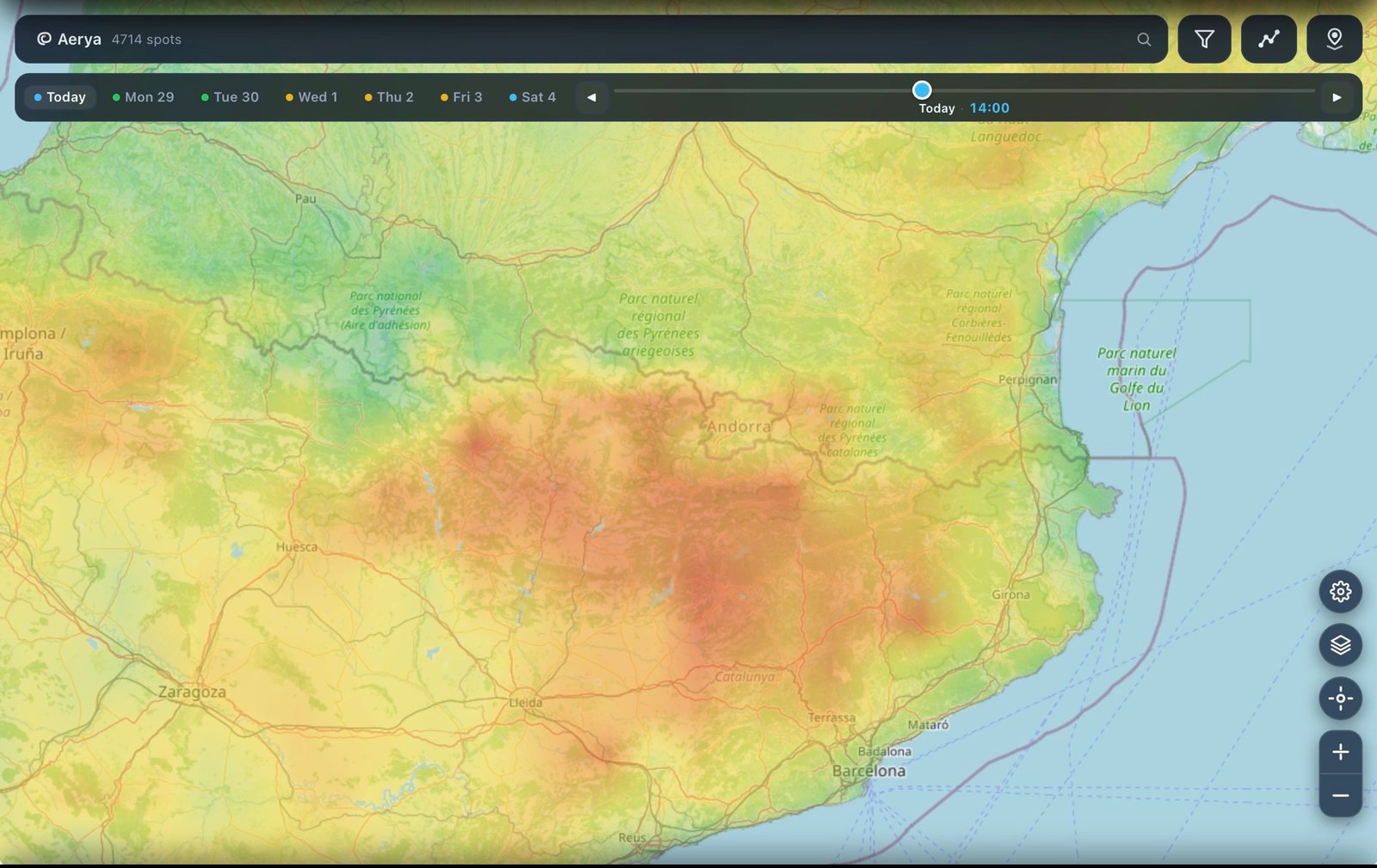
Look at Aerya's hourly thermal-strength curve for your site. Match it against what you actually observed. Over time you'll learn how the forecast maps to reality — some sites over-forecast, some under-forecast. Building that calibration is what separates good pilots from great ones.
4. Track the seasonal shift
The same launch is a completely different site in April vs. July. Sun angle, day length, and air mass characteristics all shift. A "1 pm launch" site in summer is a "12 pm launch" site in spring. Note this in your logbook.
The good launch decision framework
Before you clip in, run through these four questions:
- What phase am I in? Warm-up, switch-on, peak, decline, or shutdown. Match your ambition to the phase.
- How much window is left? A 45-minute flight in the peak beats a 90-minute struggle across warm-up and decline.
- Is the sky ahead of me still going to be working when I get there? Think about transition time vs. cycle progression.
- What's my out? Every phase change has a graceful ending — a landing zone, a restitution slope, a bail-out route. Have one before launching.
The pilots who consistently fly big distances aren't reading a different forecast than you. They're reading the same forecast against a mental model of the day's cycle. Once you have that model, everything else clicks into place.
See today's hour-by-hour thermal cycle
Free on iPhone. Aerya's hourly forecast shows exactly when thermals switch on, peak, and shut down for your site.
Download for iPhone →